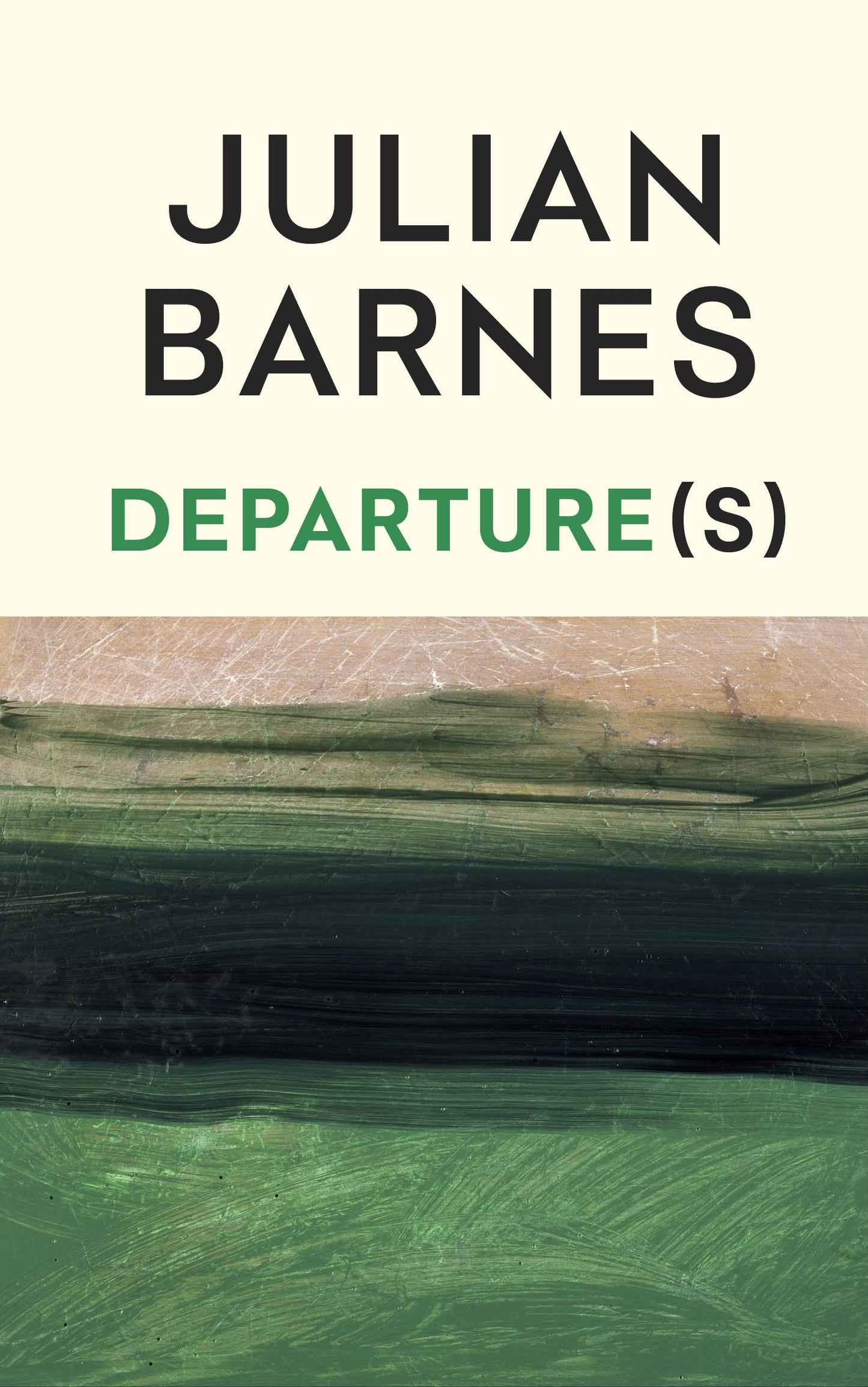

Julian Barnes
Departure(s)
Departure(s)
Couldn't load pickup availability
The final book from the Booker Prize-winning, Sunday Times bestselling author
Departure(s) is a work of fiction - but that doesn't mean it's not true.
SUSAN'S REVIEW
Julian Barnes belongs to the generation of experimental British male writers who rose to prominence in the 1980s: Ian MacEwan, Martin Amis, Salman Rushdie, Kazuo Ishiguro and Graham Swift. I’ve been a huge fan of Barnes’s work since the beginning of his career and have always eagerly anticipated the next book from this highly prolific writer. It was with some sadness then, as well as apprehension, when I read that Barnes had been diagnosed with a rare form of blood cancer, and that his recently released and aptly named Departure(s) will be his final book. The much better news, however, is that the cancer is what the doctors call “manageable”; that Barnes will in all likelihood die “with” rather than “of” the disease. Nevertheless and understandably, Departure(s) is imbued with a sense of loss as he confronts his physical decline and fading memory, as well as continuing to mourn the loss of his beloved first wife. But Departure(s) is neither a sorrowful nor self-pitying book; nor is there any sign in a diminishment of Barnes’s mental faculties. On the contrary, he faces the reality of death with equanimity, and combines his characteristic blend of intellectual flair, wry humour, emotional restraint and elegant prose.
Departure(s) is also hybrid in form, as if Barnes is gathering together the various genres in which he has published over the course of a long career. Combining memoir, fiction, philosophy and essays, the book is predominantly narrated by a man called Julian, some of whose experiences are based on those of the “real” Julian Barnes: his upbringing, education, marriage, a writing career, the death of his wife, and a recent second marriage to a woman he’s known for 30 years. It’s all factually verifiable; unambiguously true. But what are we to make of the story that weaves its way through other narratives and reflections: a youthful and intense love affair between Stephen and Jean, Julian’s two university friends, who decide to break up, then rekindle their relationship forty years later, partly with the help of Julian, only to break up again. Did this actually happen? Or did Barnes invent it? Is this blurring of the boundary between fact and fiction another example of the metatextuality for which his work is known? Or, given the book’s concern with the unreliability of memory, is Barnes reminding us that recollections of the past are always and inevitably the product of invention? Or perhaps he wanted to imagine an experience radically different from his own. Or perhaps he simply wanted to remind himself, as well as his readers, that we all crave a “good” story.
Above all, as befits a final book, Barnes is fascinated by the question of what makes for a meaningful life. While I found the highly abstract first section about the nature of memory intellectually dry and inclined to be repetitive, the writing thereafter is accessible, entertaining and thought-provoking. Barnes’s exploration of love, for example, asks us to consider whether love is made manifest in words or in actions; whether Stephen’s constant protestations of love amount to a smothering of his partner; and whether Jean’s reluctance to say “I love you” suggests a refusal to mouth empty words or an inability to commit to a long-term relationship. Barnes also discusses the ways in which creativity and reading are a source of existential meaning. Even his pet dog Jimmy Jack Russell — endearingly loyal and madcap hilarious — provides meaning to his life, as well as the opportunity for further philosophising: at one point, Barnes wonders if a dog can have thoughts, to which a friend retorts that Jimmy doesn’t even know that he’s a dog. The joke effectively asks whether people, unlike non-human animals, are discontent because they are burdened by self-consciousness and an awareness of mortality. In this context, Barnes writes sparingly about his paralysing grief at the unexpected death of his first wife (he has written movingly, and at length, about this experience in his wonderful 2013 memoir Levels of Life). After all these reflections about “meaning,” Barnes ultimately decides what really matters in life: “finding happiness and knowing when it’s time to die.” His use of simple language paradoxically expresses a profound philosophy of life: that we need not fear death if we’ve experienced, as Barnes surely has, a life enriched by love, friendship and writing.
Departure(s) is also a book about the relationship between the writer and the reader. Barnes sometimes addresses us directly, and asks us to relate his own experiences to ours. He takes us into his heart, as well as into his thoughts and imagination. And in the book’s final section, ironically entitled ‘Going Nowhere,’ Barnes touches on his “departure” as an author. I will leave you to discover, at the book’s conclusion, his beautifully understated words of gratitude for decades of writing and for being read. As one happy reader of Barnes’s work, I’m particularly grateful for the brilliant inventiveness of Flaubert’s Parrot, the subtle humour of Arthur and George, and my especial favourite, The Noise of Time, which deals with effects of artistic subservience to a despotic regime: published in 2016, it remains a chilling book for our own troubled times.
Departure(s), in the form of a handsome hardback, is now available at the Lane Bookshop.
Susan
PUBLISHER REVIEW
Julian Barnes’s Departure(s) arrives as a deliberately slippery, genre bending finale to his 45 year career, blending memoir, fiction, philosophy and autofiction into something that is “not quite a novel,” as several critics have noted. The book opens with meditations on involuntary memory and the quixotic nature of recollection, echoing Proust while also reflecting Barnes’s diagnosis with a rare but manageable blood cancer. These reflections on ageing, illness, and the construction of self form the book’s philosophical backbone, with reviewers emphasising its hybrid nature and its refusal to sit neatly within traditional categories.
Interleaved with these personal essays is a resurrected love story: Stephen and Jean, two former Oxford students whom Barnes once introduced and whose relationship he privately championed. Their youthful romance fizzled after 18 months, only to be rekindled four decades later — a reunion Barnes facilitates and then narratively interrogates. Critics highlight how Barnes knowingly breaks his promise not to write about them, turning the tensions, betrayals and disappointments of their second attempt at love into a metafictional exercise in authorial responsibility. The book’s shifting ground — what is real, what is embellished, what is memory performing its tricks — is one of its deliberate pleasures.
As a final act, Departure(s) becomes a valediction: Barnes contemplating mortality with mordant humour, hard won acceptance, and a gentle refusal to offer grand last words. Critics describe it as unexpectedly funny in places — including moments involving an elderly Jack Russell — but also deeply moving, a work suffused with the calm of someone who has made peace with life’s narrowing horizons. If this really is Barnes’s last book, many reviewers argue he exits with grace: a slim but resonant meditation on memory, love, death, and the stories we cannot help but tell, even when we promise not to.