
Charles King
Every Valley
Every Valley
Couldn't load pickup availability
Peta's Review
Have you ever wondered why the audience stands, seemingly without prompt, during the Messiah’s “Hallelujah” chorus? Apparently it’s because when King George II attended the London premier performance on 23rd March 1743, he spontaneously rose to his feet, so moved was he by the chorus. If the King stands, everyone must also stand. And stand they did, not only then, but even today. A great story, but unfortunately there is no first-hand account of this having occurred. However, this is an extant letter by Abigail Adams to her son in 1785 which does appear to give credibility to the story. Adam wrote after attending a Messiah performance:
When it came to that part, the Hallelujah, the whole assembly rose…
I could scarcely believe myself an inhabitant of Earth.
Adams was the wife of John Adams, second president of the United States of America, and mother of John Quincy Adams, the sixth president. At the time of the performance, the Adams were living in London, John having been appointed the first US minister of the Court of St James. As Charles King in his book, Every Valley, affirms, the Messiah remains the only piece of classical music that reliably brings audiences to their feet, regardless of whether there is a monarch present or not.
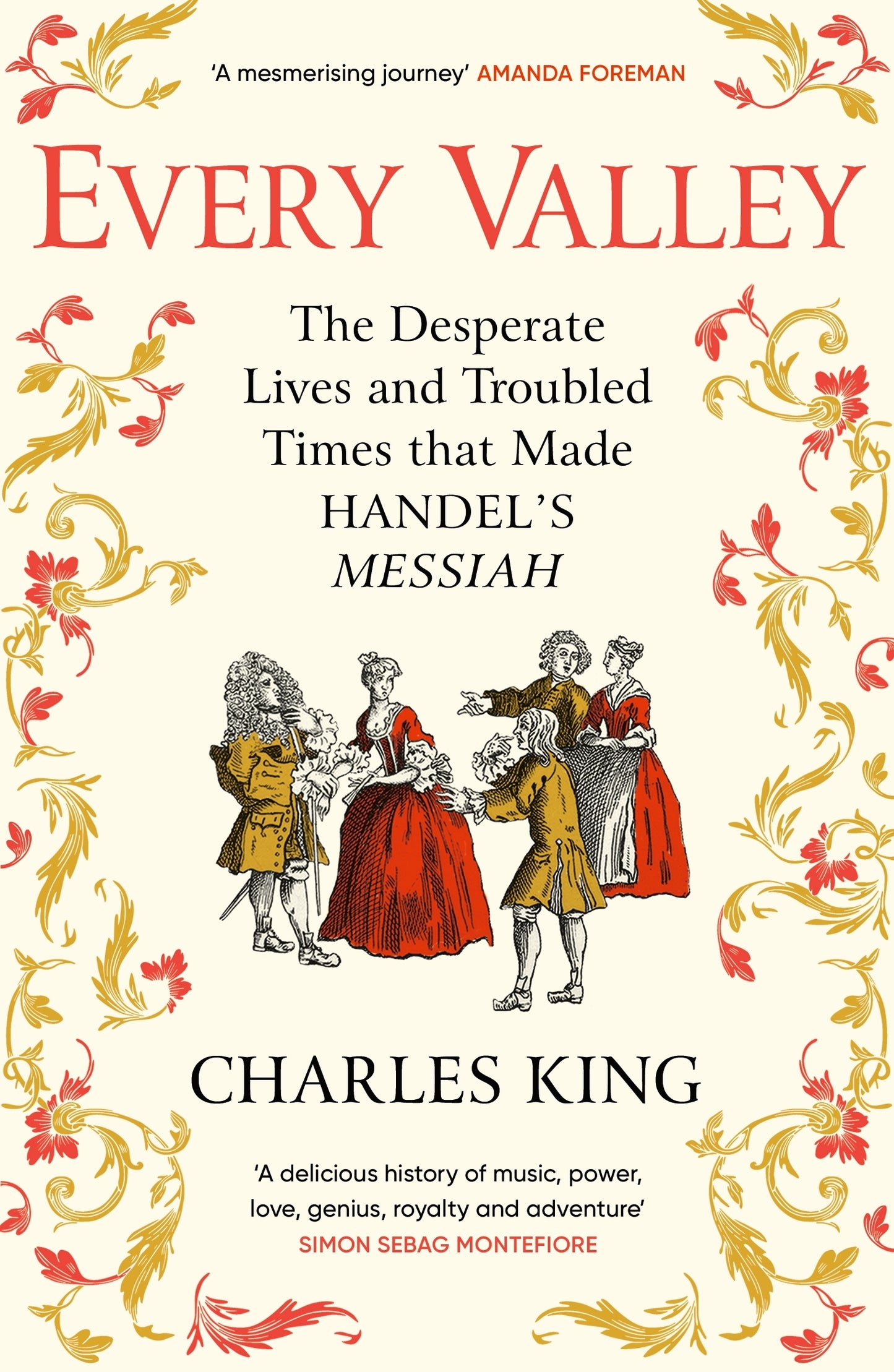
Every Valley: The Desperate Lives and Troubled Times That Made Handel's Messiah (2024), by Charles King, is a wonderful read. King brings together not only an eclectic assemblage of characters but also shows in an entertaining way that history does not happen in isolation, not even the writing of one of the most recognisable pieces of classical music, Handel’s Messiah. The ‘troubled times’ backdrop is 1740s England, the Hanoverians having been declared the rightful successors to the British throne under the 1701 Act of Settlement and the Stuarts having been dismissed as rightful heirs, resulting in great political unsettlement. The ‘desperate’ players include George Frideric Handel, a German-British Baroque Composer well-known for his operas and oratorios and composer of the Messiah; Charles Jennens, Jacobite, philanthropist, art patron and author of the Messiah’s libretti; Susannah Maria Cibber, perhaps the most celebrated tragedian of English theatre, who was sold by her husband to another man, and Handel's preferred contralto for the premiere and numerous subsequent performances of Messiah; Thomas Coram, sea captain and philanthropist who established the Foundling Hospital for abandoned children, and hosted regular benefit concerts led by Handel; Ayuba Suleiman Diallo, a West African Muslim scholar who was enslaved, transported to America, and later became a celebrity in London society: his portrait in the National Portrait Gallery is turned, in King’s words, toward the geography of Handel’s London; and Jonathon Swift, author of Gulliver’s Travels, Dean of St. Patrick's Cathedral in Dublin, who after much protest allowed the premier of the Messiah to be performed in a secular space. And this all combines to provide, according to historian Simon Montefiore, a fascinating story of “music, power, love, genius, royalty and adventure.”
George Frideric Handel’s Messiah (1741) is one of the most performed, recognised, and enduring choral works in Western music. Since its premiere, it has maintained a near-continuous presence in the global repertoire, particularly now during the Advent and Easter seasons. In his Epilogue, King argues that it “took a universe of pain to make a musical monument to hope.” Hope, as we know first-hand, can be hard to hold on to in troubled times, but as Charles Jennen wrote, “it can be physick’d.” The Messiah is an example of this. As King stresses, Handle’s Messiah continues to move listeners because its lessons are universal. After all, King points out, every performance since its premiere still begins with the same two words: “Comfort ye”.
Every Valley: The Desperate Lives and Troubled Times That Made Handel's Messiah is a book from which I learnt so much, not just about the writing of the famous choral piece, but also about the arrival of the Hanoverians, the challenge by Bonnie Prince Charlie, in an attempt to restore the Stuart monarchy, and the huge human effort it took to bring about the abolition, finally, of slavery. It also reminded me that music really does have the power to effect change. A wonderful read. Great for book clubs too. It is available in both hardback and paperback.