
Dominic Amerena
I Want Everything
I Want Everything
Couldn't load pickup availability
Susan’s review of I Want Everything
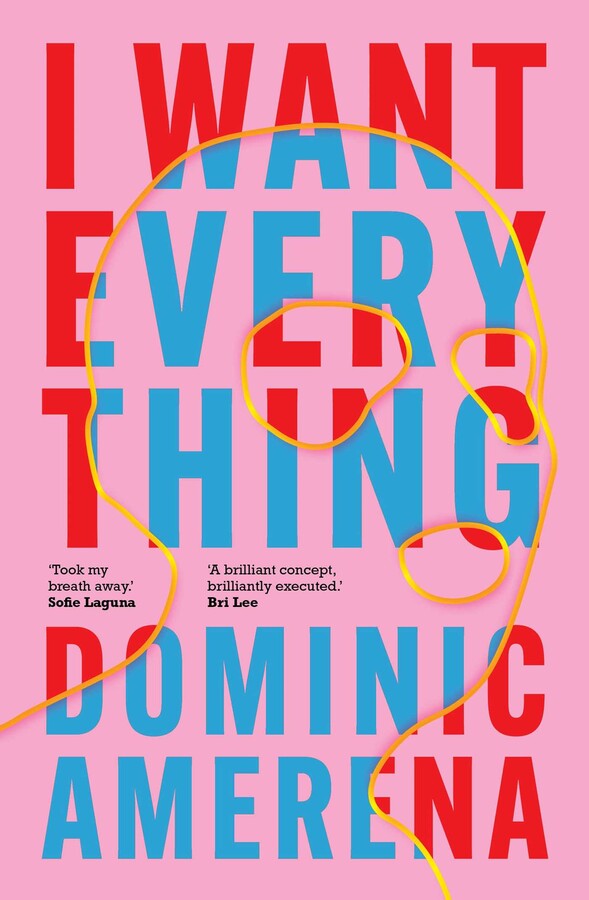
Question: what do you get when an ambitious writer tries to steal the story of a legendary novelist who went into hiding after a literary scandal which seemed to have involved her plagiarising other writers’ novels? Answer: not, as that question suggests, a convoluted plot but a clever and entertaining novel called I Want Everything. Australian writer Dominic Amerena’s debut work of fiction, recently longlisted for the 2026 Miles Franklin Literary Award, is both a serious exploration of ethical issues about authorship and a highly enjoyable black comedy about the cost of the desire for fame.
The unnamed narrator of I Want Everything is hungry for public acclaim, but while he’s keen to write The Great Australian Novel, he is also, by his own admission, too lazy and unimaginative to write anything at all. Until good luck comes his way: after befriending the famously reclusive (and fictitious) Australian writer Brenda Shales by pretending to be her long-lost grandson, he persuades her to tell her unknown story in the secret hope of appropriating it for himself.
I Want Everything in fact creates two stories. It alternates the narrator’s manipulative if guilt-laden commentary about his discussions with Brenda, and Brenda’s vibrant, immersive stories about the oppressed lives of women in 1950s and 60s Australia. It’s one of the novel’s several ironies that both the narrator and the reader begin to suspect that Brenda is telling a whole pack of lies. At one level, we’re reminded that all ‘true’ stories are the product of embellishment and invention. At the same time, however, Brenda’s stories are so captivating — her sharp tongue and feminist ire echo the work of Helen Garner and Germaine Greer — that matters of truth seem of little account. Why let lies get in the way of an emotionally powerful and vividly detailed narrative? Brenda’s story might not be ‘authentic,’ but it’s nevertheless a compelling portrait of a woman’s battle for recognition in a misogynistic culture.
In considering the ethics of authorship, I Want Everything is also deeply concerned with the morality of mining the experiences of real people. This put me in mind of two novels that erase their autobiographical status. One is Debra Adelaide’s recently published When I’m Sixty-Four. Although it’s described and marketed as a novel, it’s conspicuously based on the life of Adelaide’s friend Gabrielle Carey, who suicided in 2023 after years of depression. Helen Garner’s 2008 novel The Spare Room is another case in point: fuelled by the narrator’s anger at a friend’s refusal to accept she’s dying of cancer, the book is a thinly disguised version of one of Garner’s friends who many readers have easily identified. Do such examples constitute an invasion of privacy, particularly given the sensitive nature of their material, in the interests of creating a good story? Dominic Amerena places this important question at the moral centre of his novel while refusing to moralise or make easy judgements. The clever twists and turns in the plot, as well as its mordantly funny take on writerly ambition and masculine ego, make I Want Everything both a page-turner and a thought-provoking work of literary fiction.
