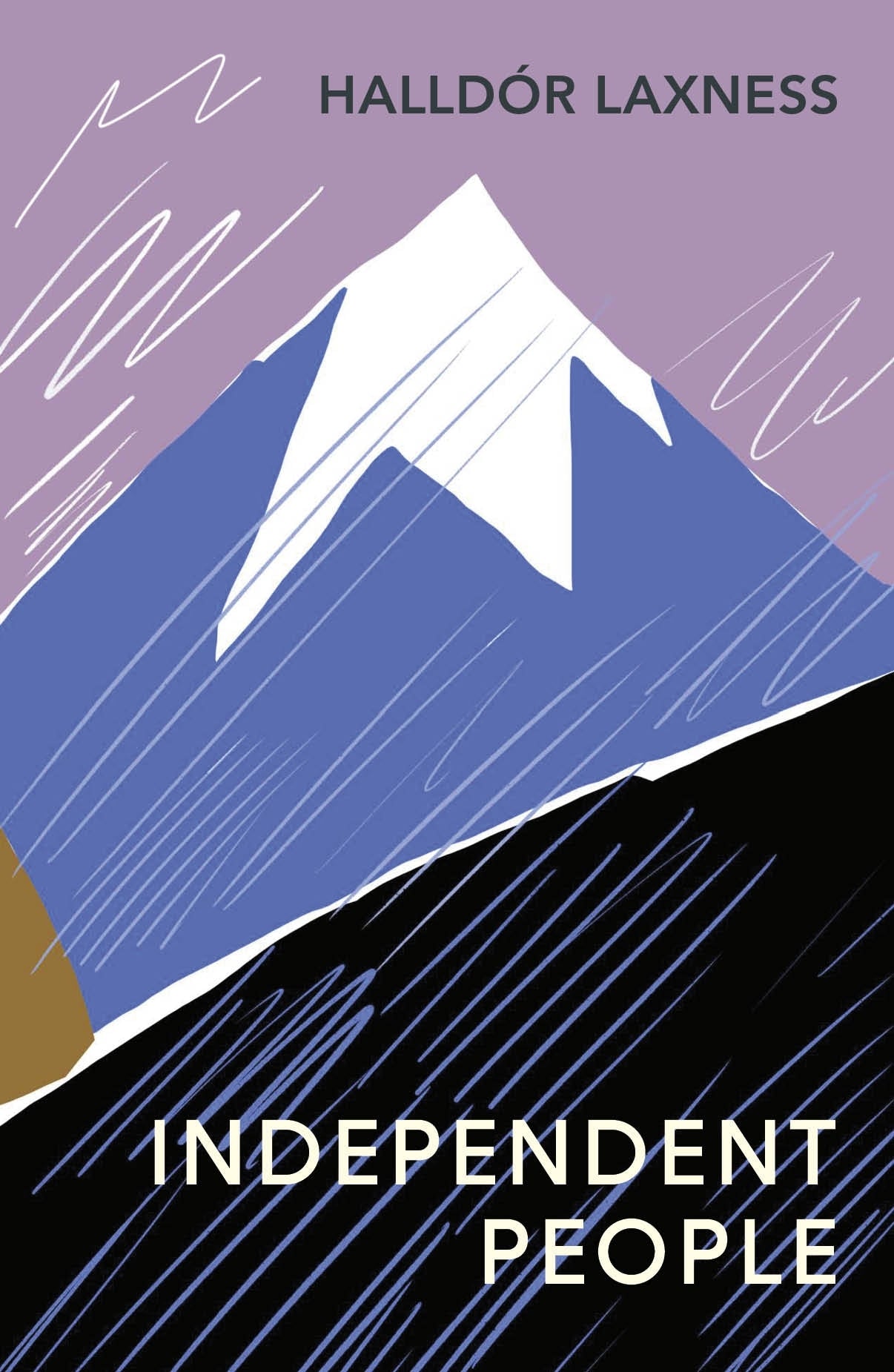

Halldór Laxness
Independent People
Independent People
Couldn't load pickup availability
The great Icelandic novel written by a Nobel prize-winner, this is a magnificent portrait of the eerie Icelandic landscape and one man's dogged struggle for independence.
Sam's Review
I'm still scarred from reading Thomas Hardy's Tess of the d'Urbervilles as a teenager. Because I grew up in the English countryside and had friends whose fathers were gamekeepers, groundskeepers and farmworkers, I should in theory have been able to relate to the agrarian lives Hardy depicted. Crucially (and thankfully), however, my friends' existences weren't ones of relentless misery, abject poverty and utter tedium. As a result, not only did I fail to relate to Tess; I came to loathe my English class’s weekly visits to the muddy fields of Wessex.
Nobel Prize-winning writer Halldór Laxness' novel Independent People depicts a similarly rural, similarly miserable existence to the one found in Hardy’s tales, but this time we’re transported to Iceland. The book was recommended to me by Douglas Bruton, one of my favourite writers, at a Lane Bookshop event in December. And so, despite the ghosts of Hardy coming into view, I felt obliged to overcome my prejudices and delve into its 600-odd pages of sheep farming and scraping by. I'm glad I did.
First published in two volumes in 1934 and 1935, Independent People begins in rural Iceland around the turn of the 20th Century (the year is never specified). Guðbjartur Jónsson, or as he prefers to be known, Bjartur of Summerhouses, has recently bought his own farm after many years of working as a shepherd for the local bailiff and his poetry-loving wife, a woman who champions the common folk of the countryside from the comforts of her well-to-do home. The name Bjatur means bright or fair, but the man is as belligerent and ill-tempered as the rams he values above all else, and determined that he and his family shall live as 'independent people', beholden to no one either by finance, favour or affection. His taciturn refusal to compromise is both his making and his undoing; for his family he is an “immutable fate, a source of adversity which they could neither control nor accuse of responsibility”.
The story follows thirty or so years of Bjartur's life as tragedy continually befalls him. Family members die, fortunes are lost, sheep get worms and all events are treated as an inconvenience to move beyond: “[N]ever harbour your grief, never mourn what you have lost.” If stoicism had a face, it would be the weathered, sour grimace of Bjartur. There is, however, one ray of light in his life: his daughter Ásta Sóllilja, whose name means ‘little flower’. Her biological father is the son of the bailiff Bjartur previously worked for but Bjartur, counter to his usual prideful self-sabotage, raises Ásta as his own and her presence is the one thing that risks bringing a smile to is face. Despite his love for her though, Ásta still goes on to suffer because of Bjartur’s granite-like stubbornness.
For all the hardship, ill-luck and self-injury, the unchanging diet of salted fish and occasional stewed mutton, reading Independent People is a ramble rather than a trudge. Unlike Hardy, Laxness injects sardonic wit aplenty into his writing. Frequently it is deployed to highlight the deficiencies in Bjartur’s life, such as the bafflement of his children when they finally receive bible lessons: “[I]t was a complete mystery to them why the women should have had such a passionate desire for an apple when they had no idea of the seductive properties of apples and thought they were some sort of potatoes.”
Independent People is feted as one of the finest examples of the social realism of its time. My ignorance of Icelandic history is bettered only by my ignorance of sheep farming, but even I could appreciate how Laxness depicts the changing nature of Icelandic society as the century progresses. From the fading knowledge of the country's traditional culture, (especially the epic poems which Bjatur steadfastly clings to) to the move from an agrarian to capitalist society (sped on by the fortunes made during World War I from increased mutton and wool exports), Laxness shows a deep love for his country and its hard-worn population, and reveals how those with least influence suffer the most.
The book is an undertaking. You need to invest your time in it. But like all good investments, you will reap the rewards. Laxness shares Hardy's anti-idealistic view of rural life and Dickens' moral purpose and use of humour. He has empathy for all his characters but refuses to sugar-coat their existence; he respects the reader while refusing to give us happy endings. On the face of it, Independent People has far too many sheep and far too little joy to be a book to recommend, and yet I feel compelled to do so. It's an epic tale of a small, stubborn life which asks to question our own – what we value, what we are prepared to sacrifice for these values, and what effect our sacrifices have on those around us. None of us want to be sheep but, in single-mindedly ploughing our own furrow, do we neglect those we love?