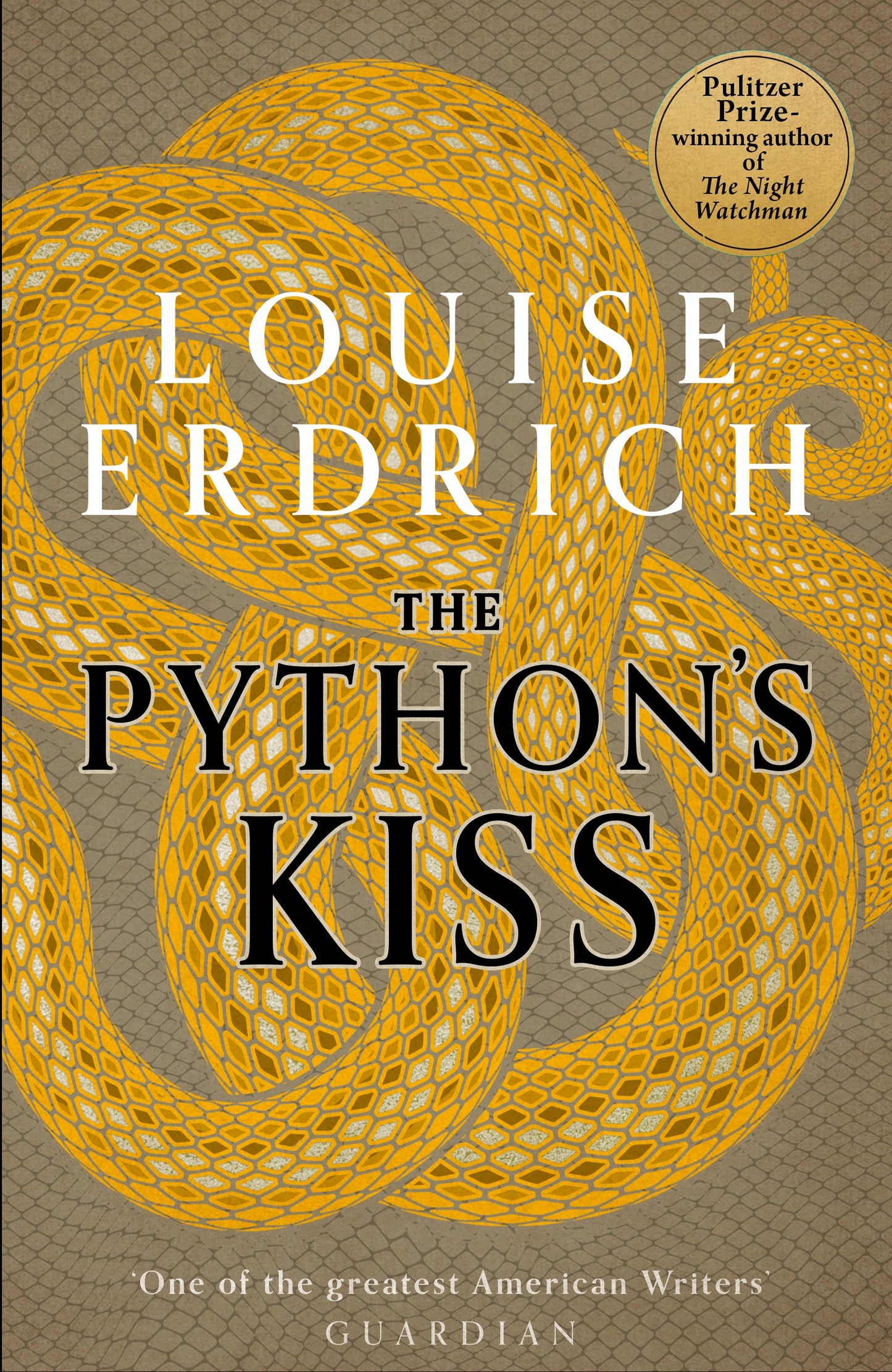

Louise Erdrich
Python's Kiss
Python's Kiss
Regular price
$34.99 AUD
Regular price
Sale price
$34.99 AUD
Taxes included.
Shipping calculated at checkout.
Quantity
Couldn't load pickup availability
The thirteen stories in The Python’s Kiss, a new collection of writing from across two decades, offer a subtle argument for the singular literary restraint that characterises Erdrich’s work. Erdrich lets her themes of familial bonds, relationships with animals, culture and identity do their work as the bedrock beneath ordinary circumstances. Her characters project their deepest longings onto the landscape and the objects in their hands, and in that displacement, she honours her Ojibwe heritage while writing something universally piercing about human fallibility.
The closing story, “The Stone,” is one of the finest demonstrations of this within the collection. A girl chooses a beautiful river stone as her lifelong companion. The rock obliges by being exactly a rock: heavy, cold and silent, but alive with all the girl’s mystical projections. Its magic is entirely psychological. The rock is nothing but an anchor tying her to the earth and to the long line of people who walked it before her. Nothing supernatural is asserted, and yet the animate world of Indigenous American heritage is everywhere as the story unfolds.
“Wedding Dresses” illustrates displacement through comedy. Aunt Dora’s basement, with its stored zombie wedding gowns, fascinates her young niece. The wedding dresses have been ruined, waterlogged by a burst pipe, and must be disposed of. Dora takes the opportunity to narrate the failed marriages each gown represents. The bridal gowns read as a physical timeline of a woman navigating multiple cultural worlds, from mainstream Western vintage at one end to traditional Ojibwe ribbon skirts at the other. The larger metaphor is the American Midwest and cultural integration. The dresses are funny before they are nostalgic and revelatory, which is part of the delight of Erdrich’s craft.
“Domain” and “Asphodel” transport Erdrich’s themes into the modern era of corporate behaviour and its effects on the traditions of Indigenous people. The reader drops out of everyday realism into a digital afterlife run by a corporation. The jolt is deliberate. If the rest of the collection works the soil of the Midwest, these two stories ask what happens when late-stage capitalism tries to strip-mine the soul of it. A proprietary server where consciousness is uploaded for a subscription fee is not a sci-fi flourish here; it channels an older anxiety about distant boardrooms deciding who survives. Old-world values get commodified. Grief gets weaponised inside a machine. The tonal break is the book’s most daring move, but the thematic line back to a living Indigenous culture under pressure from modern capitalism is clear.
Some of these stories are whimsical, charming or illustrative, but what holds the collection together is the subtlety with which Erdrich keeps her world animate while grounding that perception in human psychology, ancestral memory and the bonds of family survival. The stone is just a stone. The dresses are just dresses. The server is just a server. The meaning is what people carry to them, which is, of course, the whole point.