
Carlo Rovelli
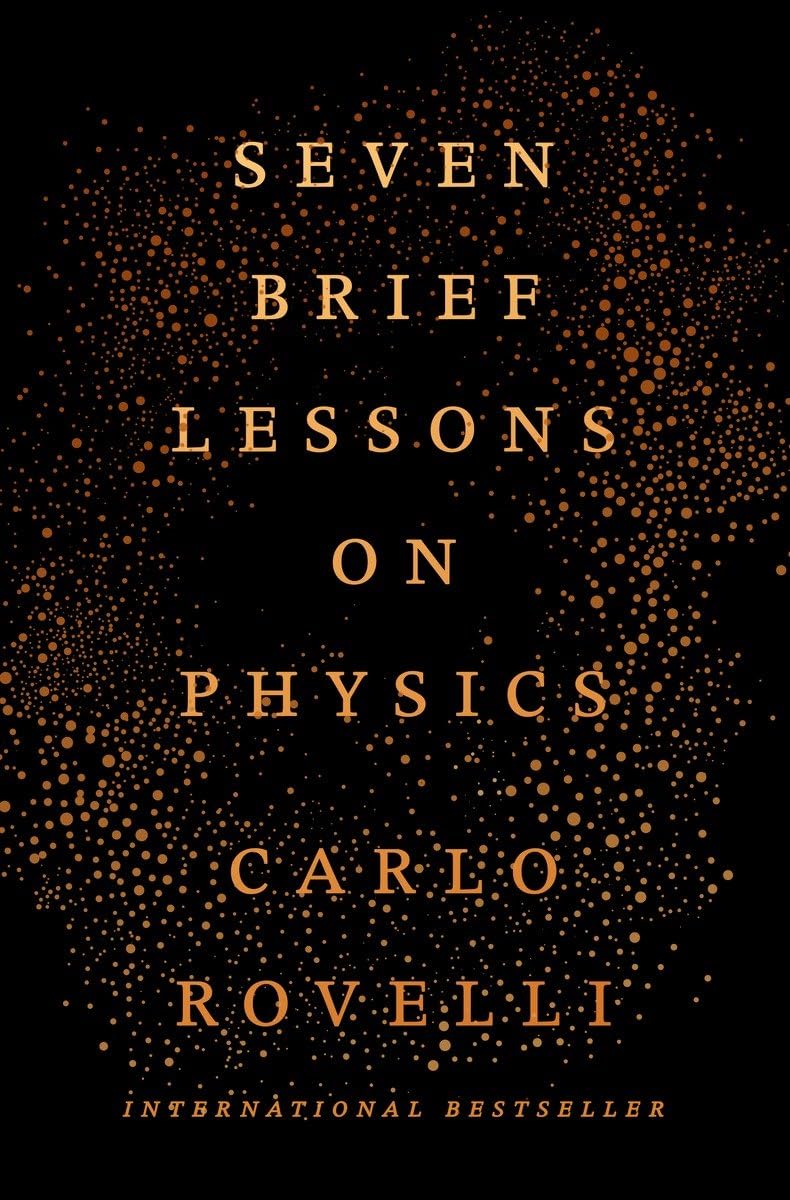
Seven Brief Lessons on Physics (10th Anniversary Edition)
Seven Brief Lessons on Physics (10th Anniversary Edition)
Couldn't load pickup availability
A playful, entertaining, and mind-bending introduction to modern physics.
'One of the best books of the 21st century' (Guardian)
Sam's Review
“Here, on the edge of what we know, in contact with the ocean of the unknown, shines the mystery and beauty of the world.”
This sentence towards the end of Carlo Rovelli’s Seven Brief Lessons on Physics sums up its brilliance. While the book, as per its title, provides concise introductions to six of the core theories of modern physics and their relevance to our lives, the sentence also shows that the book is far more than just mere information. Its 78 pages are also poetic, philosophical, and inspirational.
Rovelli is an Italian theoretical physicist and philosopher who the magazines Prospect and Foreign Policy have called one of the world's most influential thinkers. He first published Seven Brief Lessons on Physics in Italian in 2014, with the English language version, translated by Simon Carnell and Erica Segre, arriving in 2015.
The book was written “for those who know little or nothing about modern science ... Because science shows us how to better understand the world, but it also reveals to us just how vast is the extent of what is unknown.” Rovelli, with oratorial flourishes, provides primers for the theory of relativity, quantum mechanics, the cosmos, elementary particles, quantum gravity, probability and the heat of black holes, before contemplating how we think about ourselves in light of these theories.
Rovelli writes with charm and clarity (his translators must be commended for retaining both his poetry and his lucidity). When discussing the flow of time, for example, he asks us to compare ‘now’ with ‘here’:
‘Here’ designates the place where a speaker is: for two different people 'here' points to two different places ... But no-one would dream of saying that things ‘here' exist, whereas things which are not ‘here’ do not exist'. So then why then do we say that things that are ‘now’ exist and that everything else doesn't.
The charm comes in how he illuminates his points:
We can write formulae that tell us how things vary in relation to their ‘position’, or how the taste of a risotto varies as a function of the ‘variable quantity of butter.’ Time seems to
flow, whereas the quantity of butter or location in space do not ‘flow.’ Where does the difference come from?
Did I mention that he was Italian?
The philosopher in Rovelli appears in his reflections on our place in the universe: “There is so much space up there that it is childish to think that in a peripheral corner of an ordinary galaxy there should be something uniquely special.” He also considers the current retreat from scientific thinking towards gut instincts by claiming that “[m]yths nourish science, and science nourishes myth.” He encapsulates what it means to be human: "It is not against nature to be curious: it is in our nature to do so."
Rovelli does not pretend that science has all the answers, or that the answers it does provide are simple to understand. But as he takes us through the history, present and future of six theories of physics, he shows that this uncertainty is the point. Discovery is ongoing, and our inability to understand an idea or clearly explain it doesn’t necessarily make the idea false. As he points out: “The work of Einstein was initially treated by colleagues as the nonsensical juvenilia of an exceptionally brilliant youth."
Seven Brief Lessons on Physics was named as “one of the best books of the twenty-first century” by The Guardian newspaper, and I can see why. If the physics textbooks we were given at school were half as illuminating as Rovelli’s book, I might well be spending my time writing papers on the Hadron Collider rather than writing reviews for a bookshop. While I don't understand everything in Seven Brief Lessons on Physics, I will revisit it many times for its fascinating ideas, graceful prose and the sense of wonder it imparts. As Rovelli writes: “It takes a little commitment and effort. But less than is necessary to appreciate the rarefied beauty of a late Beethoven string quartet. In both cases the reward is sheer beauty, and new eyes with which to see the world.”
Publishers Review
A gorgeous anniversary edition of the international phenomenon
'One of the best books of the 21st century' (Guardian)
"One of the year's most entrancing books about science."--The Wall Street Journal
"Clear, elegant...a whirlwind tour of some of the biggest ideas in physics."--The New York Times Book Review
This playful, entertaining, and mind-bending introduction to modern physics briskly explains Einstein's general relativity, quantum mechanics, elementary particles, gravity, black holes, the complex architecture of the universe, and the role humans play in this weird and wonderful world. Carlo Rovelli, a renowned theoretical physicist, is a delightfully poetic and philosophical scientific guide. He takes us to the frontiers of our knowledge: to the most minute reaches of the fabric of space, back to the origins of the cosmos, and into the workings of our minds. The book celebrates the joy of discovery. "Here, on the edge of what we know, in contact with the ocean of the unknown, shines the mystery and the beauty of the world," Rovelli writes. "And it's breathtaking."
Not since Richard Feynman's celebrated Six Easy Pieces has physics been so vividly, intelligently and entertainingly revealed.