
Ainslie Harvey
Sisters of Scandal
Sisters of Scandal
Couldn't load pickup availability
Dirty secrets, wild romps, unruly behaviour, unapologetic rebels, wild seductresses and badasses galore ... History is HOT.
SUSAN'S REVIEW
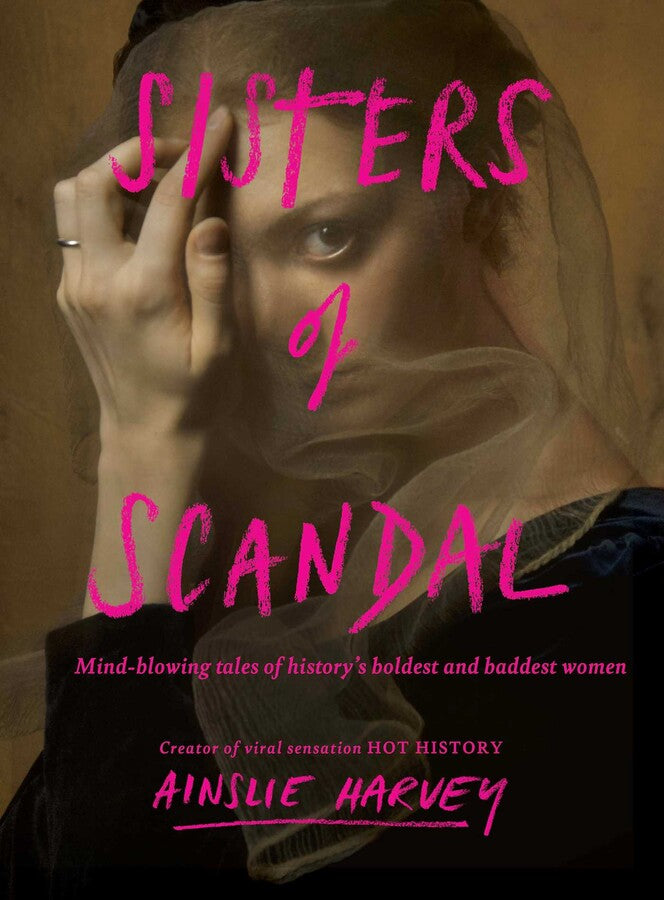
The sassy subtitle of Ainslie Harvey’s new book — Mind-blowing tales of history’s boldest and baddest women — clearly announces itself as a popular work of feminist history rather than a scholarly tome. But while I was hoping to be entertained, I also had serious misgivings about the opening description of its author as the creator of “the viral sensation Hot History” whose “titties” are “tickled [by] dead people.” This isn’t my kind of book, I thought: I’m too old and too enamoured of literary fiction to be seduced by a hip social media guru no doubt looking to boost her public profile. But within a few pages I was – to use the vernacular – “hooked”: impressed by Harvey’s range of historical knowledge and drawn to her feminist ire and feisty wit. Sisters of Scandal turned out to be a delight: full of fascinating stories – variously shocking, poignant and hilarious - accompanied by beautiful photographs and reproductions of paintings, in a handsomely produced hardback from Queensland publisher Affirm Press. To Harvey’s credit, the book also comes with a sincere trigger warning about the distressing nature of some of her material.
So what is scandalous about the sisters of the title? They were all women who shocked their own and even future generations because they defied social conventions and traditional gender norms. Or as the author puts it, with metaphoric flair: “[i]nstead of tending to wounds, she takes up her sabre. Rather than stirring the soup, she stirs the pot.” The book’s subjects, chosen from across the centuries, include warriors, socialites, artists, criminals, pirates, scientists, femme fatales and queens. Examples range from the famous Mata Hari (“the belly dancer spy”) and Cleopatra (“the maneater”) to less well-known non-European figures like the 18th-century Chinese sex worker, gambler and pirate Ching Shih. What impels Harvey’s project is not only the nature of the women’s transgressions but the fact that they had the courage, ingenuity and cunning required to defy masculine authority and expectations. Like the 12th-century crusader Eleanor of Aquitaine (“kingmaker” and “all round badass”) riding into battle, or the African American artist Josephine Baker becoming a fierce activist for civil rights. What also matters for Harvey is the importance of context to explain feminine audacity: scandalous behaviour was an escape from poverty or stifling social convention, as well as a means of gaining a foothold in a social hierarchy created by men to maintain their political and economic power.
Sisters of Scandal also has a pleasingly balanced approach to its subjects. There is certainly admiration and celebration for the scandalous women, but Harvey also refuses to gloss over well-documented moral failings. The support for slavery by the 17th-century African warrior Njinga MBande; the extravagant materialism of “the bitch” Marie Antoinette; the attraction to brutal demagogues by two of the Mitford sisters (Diana Mitford married Oswald Mosley, leader of the British Union of Fascists while younger sister Unity cosied up with Adolph Hitler). At the same time, however, Harvey is keen to correct the historical record through which male historians have typically slandered or trivialised their female subjects. Take as an example Marie Antoinette’s alleged, and notoriously insensitive, remark that peasants deprived of bread should eat cake instead. Harvey points out “there is absolutely no historical evidence to support Marie ever saying the phrase”: a statement she backs up with a detailed account of the process through which a fabrication became an accepted fact. The case of Cleopatra is similarly instructive; according to Harvey, while historical accounts have created a figure of irresistible sexual power, they failed to give credit to the intellectual vivacity with which Cleopatra “lured” men to aid her political ambitions. Harvey also carefully sifts through historical evidence to rescue the scientist Hypatia, born around 350-370 BC in Egypt, from the widespread accusation that her invention of revolutionary astrological devices was due to her association with the devil.
Above all, Sisters of Scandal insists that reading about history can and should be enjoyable. Unlike conventional histories, Harvey often uses idiomatic or colloquial language to create a friendly relationship with her readers. Here, for example, is her description of Eleanor of Aquitaine as “a woman who bore her cleavage with pride, birthed two kings, told church leaders where to stick it.” But complementing this kind of breezy style are rational and researched arguments, as well the inclusion of an extensive bibliography designed to encourage us to read more scholarly accounts of the lives of these scandalous women. So if you’re looking for an intellectually reputable version of women’s history that also provokes and amuses, I can highly recommend Sisters of Scandal. It would also make a wonderful gift for people uninterested in or bored by the study of history (as long as students take care not to reproduce, in their essays and exams, Harvey’s deliberately understated description of history as “pretty fucked up” for women).
Sisters of Scandal is now available in the Lane Bookshop.
PUBLISHER REVIEW
Did you know that women occupy only 0.5 per cent of the historical record? Diving into the lives of queens, witches, bitches and It Girls throughout the ages – from Cleopatra, Marie Antoinette and Mata Hari to the British PM’s secret weapon: Pamela Churchill Harriman – this is a fabulously illustrated compendium of those women (from the well known to the more obscure) who broke boundaries, rules and occasionally limbs, to carve out their place in the male-dominated history books.
From Alva Vanderbilt’s $6 million ball to Empress Sisi’s meat mask, we look at the boldest, most indecent and totally unruly things that pissed men off enough they simply HAD to write them down!