
Simon Winchester
The Breath of the Gods
The Breath of the Gods
Couldn't load pickup availability
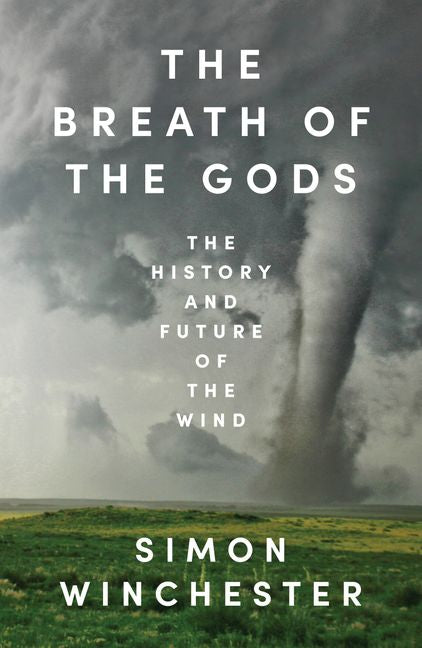
Sunday Times bestselling author Simon Winchester returns with a thought-provoking history of the wind, written in his edifying and entertaining style.
GABI'S REVIEW
Simon Winchester’s The Breath of the Gods: The History and the Future of the Wind is a perfect Christmas gift for the non-fiction lover. This immersive book features the many facets of an invisible force that shaped human civilisation in surprisingly profound ways. Long before we had science or before any human scratched cuneiform into clay, the wind was already teaching us how to harness its energy: from kites to woodwind instruments, trade and travel, and more recently to its role in shaping our advanced technologies. Winchester goes even further, emphasising our fundamental dependence on this vital force.
The book illustrates how Gods of the wind go back to ancient cultures. More than quaint myths, the forces of physics were translated into narrative about entities of supernatural power with either reliably benevolent or catastrophically unpredictable natures. Harnessing the wind, for example, carried Austronesian-speaking people — the ancestors of Polynesians — across 7,000 miles of open Pacific on boats made of lashed bamboo. Without compasses, people read the wind and ocean currents like a book. Winchester shows wind as navigator, destroyer, muse, and the driving engine of discovery through the invisible highway of the trade winds. Steady and predictable, these winds moved vessels along the coasts of Arabia and India, shaping empires in their wake and inventing the modern world.
Winchester has a knack for making complex physics accessible and engaging. He tells us how wind arises from the sun heating the atmosphere asymmetrically at the equator, causing warm air to rise to the tropopause and flow poleward. The sinking air then returns equator-bound, deflected by Earth’s rotation into the vitally historic trade winds. This loop on each side of the equator is called a Hadley cell. While there are others, the Hadley is the planet’s main heat-moving engine, constantly redistributing tropical warmth. This fundamental understanding sets the stage for all the dynamics that follow in the future of the wind. The industrial heating of the globe has contributed to changes in heat exchange, causing the Hadley cells to widen. Powerful jet streams are becoming slack and loopy, and parts of the world are entering something scientists call “global stilling.” This creates phenomena like heat domes over Europe, and endless rain on one coast of Africa and drought on the other. Winchester argues that we can avoid reaching an irreversible tipping point for global warming if we transform our energy production methods so that this fundamental driver of heat distribution can continue to perform its crucial function.
Anecdotal, meandering and eclectic, the book offers the reader a thorough picture of the impact of the wind on us, and in turn our effect on the wind. If charming steampunk anemometers, oboe virtuosos, seafaring cultures, physics and technology sound like an irresistible combination of elements, then this is the book for you.
PUBLISHER REVIEW
What is going on with our atmosphere? The headlines are filled with news of devastating hurricanes, murderous tornadoes, and cataclysmic fires. Gale force advisories are issued on a regular basis by weather services around the world.
Atmospheric scientists are warning that winds – the force at the centre of all these dangerous natural events – are expected to steadily increase in the years ahead, strengthening in power, speed, and frequency. While this prediction worried the insurance industry, governmental leaders, scientists, and conscientious citizens, one particular segment of society received it with unbridled enthusiasm. To the energy industry, rising wind strength and speeds as an unalloyed boon for humankind – a vital source of clean and ‘safe’ power.
Between these two poles – wind as a malevolent force, and wind as saviour of our planet – lies a world of fascination, history, literature, science, poetry, and engineering which Simon Winchester explores with the curiosity and Vigor that are the hallmarks of his bestselling works. In The Breath of the Gods, he explains how wind plays a part in our everyday lives, from airplane or car travel to the ‘natural disasters’ that are becoming more frequent and regular.
The Breath of the Gods is an urgently-needed portrait across time of that unseen force – unseen but not unfelt – that respects no national borders and no vessel or structure in its path. Wind, the movement of the air, is seen by so many as a heavenly creation and generally a thing of essential goodness. But when it flexes its invisible muscles, all should take care and be very afraid.