
George Saunders
Vigil
Vigil
Couldn't load pickup availability
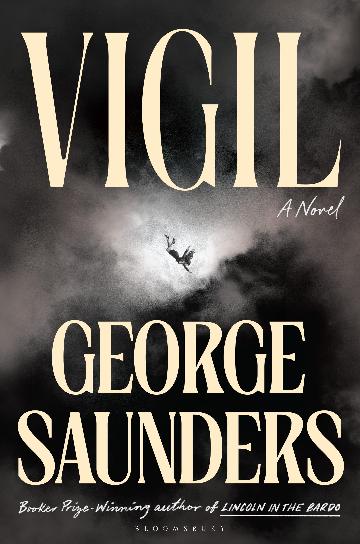
Pre-order the latest book from the Booker Prize winning author of Lincoln in the Bardo a playful, wise, electric novel taking place at the bedside of an oil company CEO, in the twilight hours of his life, as he is ferried from this world into the next. Released February 3rd 2026.
GABI'S REVIEW
George Saunders’ broad popularity stems from his unique combination of writing high-concept satire with profound, accessible empathy. While he is often celebrated as a "writer’s writer" for his sophisticated craft, his work resonates with a wider audience. This is because it addresses the absurdity of modern consumerism, corporate culture, and mass media without losing sight of the human heart.
In his new book Vigil, Saunders returns us to the notion of a bardo; a strange liminal realm in which souls seek resolution from ties that bind, before transcending to an enlightened state. In Vigil, souls are met by spirits who themselves are not entirely reconciled, and have not yet, for their own entangled and unresolved reasons, “elevated”. These spirits attach to a “charge” and appear to find purpose or comfort themselves in assisting the charge to transition. Saunder’s liminal space is an invitation to bring our own moral and philosophical framework to the world while we attempt tomake sense of its existential chaos.
The charge that comfort spirit Jill “Doll” Blaine accosts, is an oil and gas baron, K.J Boone. He represents the epitome of our extractive era and is wholly unrepentant and resistant to Jill’s efforts to free him. We view the action from Jill’s perspective. She is a fascinating depiction, as gently fragmented as Boone is loathsome and self-aggrandising. We discover the circumstances resulting in her discombobulated state, explored by Saunders in both madcap-comic and compassionate ways. At one point escaping Boone’s bedside in sheer frustration, Jill is lured by the joyful sounds of a nearby wedding. After attending the wedding, she is triggered by recollections of her earthly state, and her spirit becomes inconveniently encumbered by aspects of her former self.
The novel takes place over the day of Boone’s death. We are joined by a cast of offbeat oddballs who either obstruct, detract from or weigh in on the process of Boone’s transition. If all this sounds like a theatre of the absurd that would rival Waiting for Godot, it certainly reads that way. For me, the novel didn’t seem to be making a point about closure, come-uppance or divine retribution, but reached instead a deeply humane conclusion about the human condition. It seems to conclude there is a tragic disjunction between human experience and human wisdom. The book hits a nerve because it asks if "radical empathy" has limits. Can Jill, and by extension the reader, maintain compassion for a man who knowingly harmed the planet. Furthermore, is she the right spirit to force his repentance?
This moral tension occupies a huge part of the book’s hilarious and touching action. Saunders doesn't just make Boone a corporate caricature; his impoverished background is explored as the driver of his ruthless ambition, concluding that his character was an inevitable consequence of his economic circumstances. This empathic view of the villain presents him not as a moral vacuum but as a node in a complex network of historic and economic pressures. Boone's protective shell of ego becomes the very prison from which he is unable to extricate himself.
For me, Saunders presents the self is as survival mechanism within the framework of a scarcity model, with enlightenment effectively involving a de-fragging of the hard drive. I viewed the “soul” premise not as a theological claim, but as a narrative sandbox; a way to simulate the kind of metaphysical audit our current legal and social structures are too clunky to perform in real-time. For this reader, Saunders shows us our natures are a problem that can’t be yet be solved by a system, and internal value alignment remains our best hope.
PUBLISHER REVIEW
'He will be read long after these times have passed' Zadie Smith
What a lovely home I found myself plummeting toward. . .
Not for the first time in fact, for the 343rd time Jill 'Doll' Blaine finds herself crashing down to earth, head-first, rear-up, to accompany her latest charge into the afterlife. She soon realises however that this man is not quite like the others.
For powerful oil tycoon K.J. Boone will not be consoled, because he has nothing to regret. He lived a big, bold life, and the world is better for it - isn't it?
As death approaches, a cast of worldly and otherworldly visitors arrive. Crowds of people and animals alive and dead materialise, birds swarm the dying man's room, and associates from decades past show up, all clamouring for a reckoning.
In this electric novel brimming with explosive imagination, George Saunders confronts the biggest issues of our time with his trademark humour and warmth, spinning a tale that encompasses life and death, good and evil, and the inevitable question- who else could we be but exactly who we are?