
Amy Remeikis
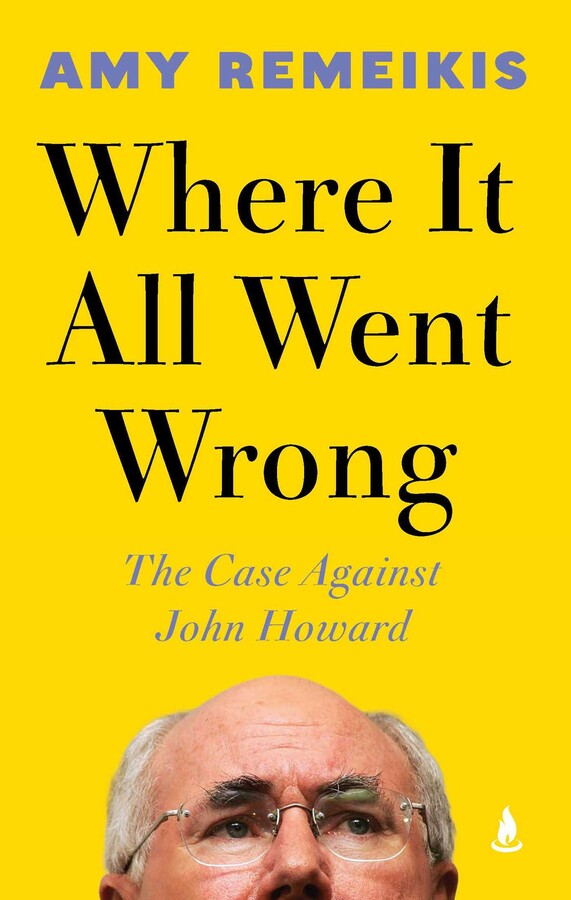
Where It All Went Wrong: The case against John Howard
Where It All Went Wrong: The case against John Howard
Couldn't load pickup availability
On the thirtieth anniversary of John Howard coming to power, a searing analysis of the untouchable prime minister: how the ‘great economic manager’ sold our future.
SUSAN'S REVIEW
I’ve long been an admirer of Amy Remeikis’s political commentary, for its intelligent, articulate commitment to social justice. I’ve also long been a critic of the policies of John Howard, the conservative Australian Prime Minister who led his party to four consecutive federal election victories, from 1996-2007. It’s hardly surprising, then, that I was predisposed to agree with the arguments Remeikis advances in her book, Where It All Went Wrong: The Case Against John Howard. But I also know that a reviewer must keep an open mind and be willing to identify argumentative flaws instead of nodding in uncritical agreement.
Remeikis’s perspective is conspicuously, indeed unashamedly leftist. It’s revealed in the book’s title and in its central thesis: that twenty years of John Howard’s conservative policies must bear most of the responsibility for creating the social and economic problems facing Australia today. In arguing her case, Remeikis covers a wide range of issues, including the housing crisis, industrial relations, migration, asylum seekers, climate change, race relations and the environment. But her critique goes beyond matters of specific policy to claim that Howard’s tenure as prime minister fundamentally changed the fabric of Australian society for the worse: more individualistic, more stridently nationalistic, and less respectful of, indeed more publicly hostile towards racial and sexual minorities, environmentalists and so-called intellectual and artistic “elites.”
How convincingly, then, does the book prosecute this damning case against John Howard? A man whose many admirers continue to praise if not revere him as one of Australia’s “greatest” prime ministers. First off, to dismiss Remeikis’s arguments because of her obvious left-wing bias misses the fact that objectivity is impossible. Tony Abbott’s recent Australia, for example, despite the appearance of scholarly neutrality, ultimately endorses white culture’s triumphalist version of the country’s history. In short, Remeikis’s leftwing perspective doesn’t in and of itself invalidate her arguments. Indeed, one of the most persuasive aspects of her book is her avoidance of political generalisations in favour of evidence-based argumentation. She analyses Howard’s legislative motives and achievements; quotes extensively from interviews and speeches which he gave to various institutions; and refers to other works, both popular and scholarly, about Howard and the Liberal Party.
Remeikis saves her greatest ire for Howard’s attitudes towards and policies about Indigenous people, through which he constructed them as both a threat to the dominant white culture and undeserving of sympathy. Remeikis highlights Howard’s scare campaign about Indigenous land rights, in which he falsely claimed that two High Court decisions would result in Aborigines taking over 78% of Australian land. She quotes from other speeches to reveal what Howard didn’t say: the historically verifiable suffering inflicted on Indigenous people by white colonisers: massacres, enslavement, the enforced removal of Aboriginal children from their families, the loss of land, language and culture. The closest Howard came to acknowledging these injustices was to refer to them as “mere blemishes” on what he saw as a proud history of white Australia’s achievements. Further, Howard’s infamous refusal to deliver a formal apology to Indigenous people showed not only his lack of compassion but a failure to distinguish between the concepts of individual guilt and collective responsibility. He made drastic cuts to or abolished Indigenous programs that were working for the benefit of their communities, and he consistently refused to consult with Indigenous people. His government’s “emergency” military intervention into Aboriginal communities, based only on rumour and hearsay about the widespread sexual abuse of children, resulted in the severe curtailment of the rights of Aboriginal people. Remeikis’s arguments in her chapter on race are often impassioned but never histrionic or hectoring; her concern is to disclose the facts instead of trying to score points against her political opponents.
The book’s analysis of Howard’s embrace of neoliberalism is, however, considerably less persuasive. Remeikis begins with the criticism that Howard’s neoliberal policies privileged profits for private companies over the welfare of the nation’s citizens. One particularly disturbing example is Howard’s privatisation of the aged care sector. His Aged Care Act 1997 enabled private equity firms, new foreign investors, and superannuation and property real estate investment trusts to enter the residential aged care market. The overall consequence – chronic understaffing, untrained staff, a lack of regulation and transparency – was the creation a system which led to the appalling neglect and abuse of elderly residents documented in the 2018 Royal Commission. Under Howard’s privatisation agenda, child care became, and remains, difficult to access and prohibitively expensive for many parents. Howard’s privatisation of energy supply has similarly led to inflated prices, as well as supply problems, for Australian consumers. These and other examples discussed in the book of the deleterious effects of privatisation also debunk the enduring myth that the Liberals have always been better economic managers than Labor. If Remeikis’s book does nothing else, it might make voters stop believing in that myth.
But – and it’s a big but – Remeikis’s criticism of Howard’s enthusiasm for privatisation is seriously weakened by letting successive Labor governments more-or-less off the hook. She glosses over the fact that it was the 1980s Hawke-Keating Labor government which first introduced neoliberal policies to the country. Remeikis also argues that Labor became so intimidated by the Liberal Party’s electoral successes that, once elected to office, it was cowed into retaining some of their policies. To name only two: paying a private company huge amounts of taxpayer money to indefinitely detain asylum seekers in offshore detention centres; and continuing to increase the number of coal mines in Australia to line the pockets of the fossil-fuel industry, one of the major donors of both political parties. We might also ask: at what point does an explanation for the continuation of such policies become an excuse not to take remediable action?
Despite this argumentative flaw, and some minor irritations like the repetition of material and some lapses into unnecessarily emotive language, Where It All Went Wrong is a highly informative and utterly absorbing read for anyone interested in the political health of the nation. It’s lively, cool-headed, angry, even wryly humorous. But is the book likely to change the views of John Howard’s admirers? It’s a rare piece of writing that has the capacity to radically change hearts and minds, but Where It all Went Wrong might at least encourage reflection on who we are as a nation and where we might be heading.
You’re welcome to order a copy at the Lane.
Susan
PUBLISHER BLURB
John Howard is often revered as one of the great Australian prime ministers (1996–2007): economically prudent, politically astute, ‘relaxed and comfortable’ with Australia’s identity, venerated by the Liberal Party and grudgingly admired by the left.
Why then – just twenty years after his government ended – are we in such a mess?
Amy Remeikis is one of our most astute and convincing political commentators, and here she argues for a complete revision of how we see Howard’s tenure, for the first time holding him to account for the future he created. Of our modern crises, most are caused by his policies. Housing crisis? Guilty. Work insecurity? Guilty. Giving away gas? Guilty. Climate denial? Guilty. Rise of the far right? Guilty. America's lapdog in foreign relations? Guilty. Jingoistic tracksuits and flag-wrapping? Guilty and convicted.
Far from being ‘great economic managers’, the Howard government bought boomer votes with franking credits and negative gearing, sacrificing the generations now inheriting the nation. They sold out their children and grandchildren for mining billionaires, investment properties and annual cruises.
Amy Remeikis is the highly informed voice of these dispossessed generations. In showing us where it all went wrong, she illuminates the path to a better future.