
James Meek
Your Life Without Me
Your Life Without Me
Couldn't load pickup availability
Susan's Review
Award-winning British novelist James Meek has always been drawn to explore morally confronting questions. One of his most acclaimed novels, The People’s Act of Love (2005), asks: under what circumstances is eating another human being justifiable? Set in Siberia during the Russian revolution, the novel features a mad despot, a bunch of religious fanatics and a flawed idealist locked in a contest over power. Similarly acclaimed is my favourite James Meek novel, The Heart Broke In (2006). Here, his gaze shifts to the contemporary ethical problems of gene therapy and internet blackmail, centred on a principled malaria researcher and her reprobate, fading-rock-star brother. Reading Meek is to enter a world that’s both meticulously researched and profoundly moving, and in which crucial social and moral issues are presented through the lens of fractured personal relationships.
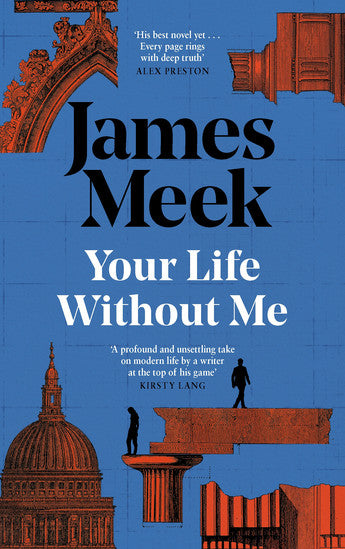
Meek’s new novel, Your Life Without Me, his first in seven years, is similarly engaging and thought-provoking, albeit with a less sprawling plot. This time its “big” question concerns the responsibility we have to the past. Meeks turns this highly abstract issue into an intriguing mix of a terrorist plot, a family drama, and a critique of architectural degradation and destruction. The novel’s dominant perspective is that of a high school English teacher named throughout as Mr Burman; a name that befits his judgemental, often censoriousness attitude, including towards his teenage daughter Leila. Leila herself - uncommunicative, surly, and inwardly self-abasing – remains in awe of her vibrant, much-loved mother, Ava, killed four years earlier in a car accident. Completing the quartet is Raf, Mr Burman’s former, intellectually brilliant student, who unsuccessfully propositioned the married Ava, has a brief relationship with Leila, and plots to blow up St Paul’s cathedral.
Sounds complicated? Yes. But that’s part of the novel’s appeal: four complex characters enmeshed in a series of events which question their obligations to the past, both social and personal. Did Mr Burnam’s radical critique of consumer capitalism encourage his former student to plant a bomb in the revered St Paul’s? Was Raf’s plan motivated by his desire to shatter society’s indifference to the grandeur and beauty of the past? Does Leila’s adulation of her dead mother make her indifferent to her future? And most egregious of all, perhaps: does Mr Burnam’s refusal to support the imprisoned Raf entail a denial of their past relationship; one which he himself admits involved having “an intellectual crush” on the gifted young man.
In charting the lives of these characters, Your Life Without Me is also deeply concerned with the reality of change. Mr Burnam in particular is enraged by the destruction of local shops in the main street of his northern (unnamed) town, replaced by “a Cash Converters, a Cash Generator and a branch of a pawnbrokers’ chain … XFC Chicken and Pizza … And if you dial 999 and tell them the high street is being destroyed, they ask what service you require, and you hang up.” Fast money, fast food, instant ugliness and the exploitation of the ignorant and vulnerable. Mr Burnam’s lengthy and sometimes hilariously dark excoriation is alone worth the price of the book. But when he, the privileged, middle-class owner of an elegant old house, chastises Leila’s work as a sales rep for what he regards as contemptibly soulless project homes, he not only disregards her rejoinder that people need somewhere affordable to live; he also choses to maintain his self-righteousness at the expense of creating a more meaningful relationship with his daughter.
In this and other matters, Your Life Without Me, is one of those admirable novels that’s satisfyingly inconclusive. Its movement backwards and forwards in time is another refusal to lay things out neatly for the reader. We’re required to fit pieces of puzzles together: what happened to Ada when she left home for a week? Did Mr Burnam really love her, or did he love how other people adored her? Is Raf a self-deluded egotist, or a well-intentioned revolutionary? Is conformist Leila ultimately the most interesting of this puzzling quartet? James Meek’s new novel is wonderfully unpredictable, clever and sharply written, with a particular gift for dialogue. One of my favourite exchanges occurs near the end of the novel, when Mr Burnam “warily” offers to listen to his daughter. He tells her that when he thinks she’s finished, he will respond to what she’s said, and “perhaps” bring in some thoughts of his own. Would she mind, he asks.
‘That’s called talking,” sa[ys] Leila. “They have already invented it.”